Zone 2, Carbs, and Eating for a lifetime of running
Zone 2 heart rate training, also commonly referred to as long-slow duration, base-building, maximum aerobic function, etc, have similar primary objectives. The two main goals of Zone 2 training are to stimulate the production of mitochondria and to teach our metabolic systems to become more efficient at burning fat.
Mitochondria are the organelles inside muscle cells that convert oxygen and nutrients into energy (ATP). They are often referred to as powerhouses of the cell. The more, and bigger, our mitochondria the greater our aerobic capacity. Simultaneously, the more efficient we burn fat, the more glycogen we have for higher intensities efforts, like running through the finish line.
There are many additional benefits to zone 2 training. They include expanding the network of tiny blood vessels (capillaries) surrounding our muscle fibers, allowing for better oxygen delivery and waste product removal. Important structural adaptions that support injury prevention also occur. Bones, tendons, ligaments, and cartilage adapt to physical stress much slower than cardiovascular tissue or muscles. Low-intensity aerobic running subjects our joints and connective tissues to necessary impact stress without overloading them, lowering injury risk over time. Zone 2 training conditions our slow-twitch (Type I) muscle fibers to resist fatigue over hours of movement. Zone 2 running produces minimal lactic acid accumulation and limited central nervous system (CNS) fatigue allowing us to accumulate higher weekly training volume without burning out or compromising harder workout days (like intervals or tempo runs). The smaller CNS load of zone 2 running is extra important for Masters Athletes.
Now to carbohydrates-do you really need them on your 2hr (or less) zone 2 run?
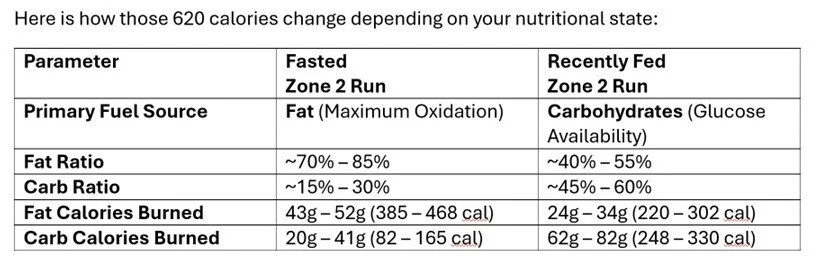
In a Zone 2 run (typically defined as 60–70% of our max heart rate), our bodies rely primarily on aerobic metabolism, using fat as the dominant fuel source. A typical runner burns approximately 60% to 70% fat and 30% to 40% carbohydrates while in zone 2. At approximately 620 total calories per hour for a 175-lb runner (that’s me!), this converts to:
~45 grams of Fat (~403 calories); ~54 grams of Carbohydrates (~217 calories)
These numbers become especially useful when we step back and look at a lifetime of running. We run for all kinds of personal reasons, but almost all of us share one common goal: we want to keep running for as long as possible, maybe even a lifetime. The better our overall metabolic health and energy management, the more likely we are to keep doing what we love for decades to come. Maybe this approach even helps lower inflammation and reduces injuries.
Everyone has plenty of available calories on board already
A 145-pound (66kg) female stores roughly 240-430 grams of total glycogen (about 960-1,720 cal) while a 175-pound (79 kg) male stores roughly 350 to 600 grams of total glycogen (about 1,400 to 2,400 calories). [Jensen, 2011; Hargreaves,2012; Murray, 2018] With approximately 80% of this total glycogen stored in muscles; ready to be used for exercise. Trained endurance athletes store even more glycogen, up to 300 grams more.
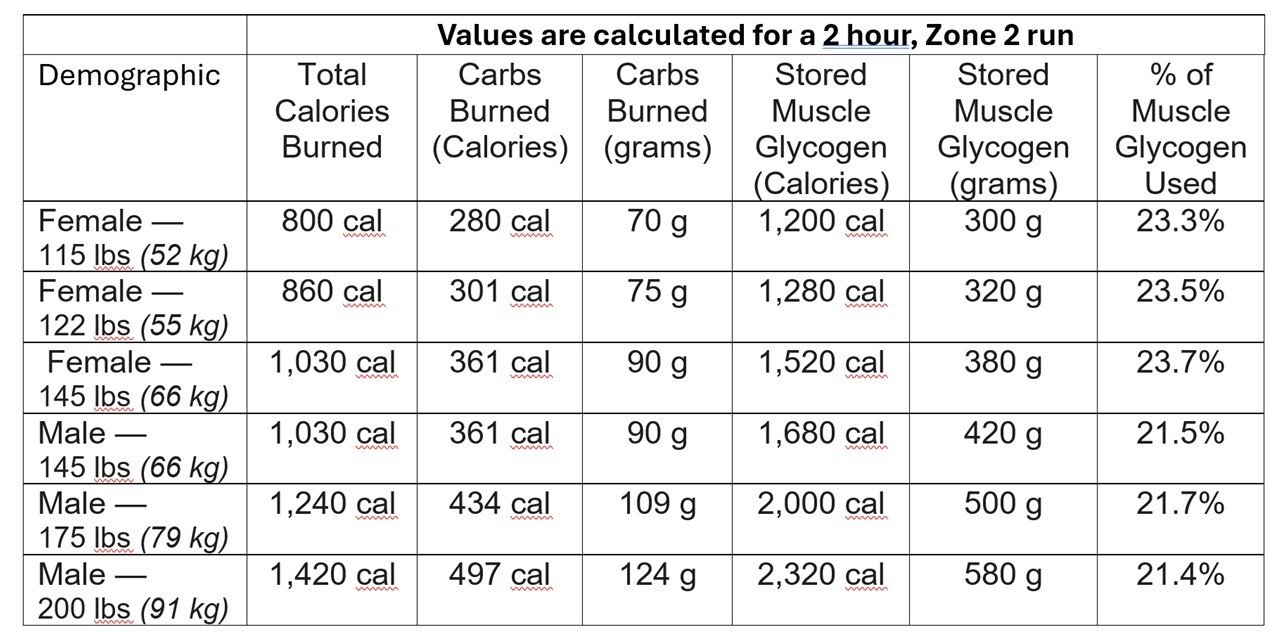
Returning to our 620 total calories per hour runner who burns 109 grams of glycogen in a 2-hour, Zone 2 run: this runner still has 391 grams of total glycogen on board. Although lighter runners have less muscle stored glycogen, they also benefit from a lower calorie burn per hour. As the table shows, essential every runner will use only about 22-24% of their glycogen stores during a 2-hour, Zone 2 run. The typical percentage of muscle glycogen that can be used is 50-60% before the warning signs of glycogen depletion start to be felt. [Yeo, 2008; Nielsen, 2011] At 22-24%, the 2-hour, Zone 2 run is significantly below the 50-60% level.
Replenishing glycogen stores from a whole food diet
Following a regular, balanced diet will restore glycogen fully in about 24 to 48 hours. The restoration of glycogen levels increases with increasing carbohydrate consumption. So even without a post-workout intake of carbohydrates (post-workout carbs are encouraged!), a runner still has plenty of glycogen available for their next day long run.
For example, the 145 lb runner has roughly 380 grams of muscle glycogen available. Following their first 2-hr, zone 2 run, they still have 290 grams of muscle glycogen. Under a normal, balanced diet, even at only 50% replenishment of glycogen at 24 hours, they have 335 grams of muscle glycogen available. Another 2-hr, zone 2 run leaves them with 245 grams, still way above the 50% threshold usage for muscle glycogen, or 190 grams.
Jump starting glycogen replenishment with a post-workout fuel
Glycogen synthesis is most rapid in the first 2 hours post-exercise due to elevated insulin sensitivity and activation of the glucose transporter (GLUT4). You can replenish 30% to 50% of depleted stores within 4-6 hours by consuming fast absorbing, or high-glycemic, carbohydrates within 30 minutes post-run. Pairing carbohydrates with protein at a ~3:1 or 4:1 ratio jump starts additional insulin release to speed up glycogen restoration. This is why chocolate milk raises to the top of the post workout fuel (Yeah for those of us who can drink milk!). Standard low-fat chocolate milk sits right in that sweet spot, typically a 3:1 carbohydrate-to-protein ratio.
A couple post run snack examples:
-16 oz (2 cups) of chocolate milk: Delivers ~48g carbs and 16g protein (a 3:1 ratio). To hit full recovery targets: Pair those 16 oz of chocolate milk with one medium banana (~27g carbs). That brings your total to 75g carbs and 16g protein, hitting your ~66–79g carb window while keeping the overall ratio right at 4:1.
-1 bottle of Ensure High Protein and 1 banana is 50 grams of carbohydrates and 17.5 grams of protein, giving a carbohydrate-to-protein ratio of close to 3:1.
-It’s also likely true that most everyone has ‘gels’ and ‘protein’ nowadays allowing an easily consumable source of carbohydrates and protein post workout.
A catalyst for building the fat burning systems
Remembering that the primary objective of Zone 2 running is to build mitochondria and improve our bodies fat burning efficiency, a comparison of fasted versus recently fed running provides useful insight.
Running in a fasted state versus a recently fed state significantly shifts your body's fuel selection—even when your heart rate remains strictly in Zone 2. The primary driver behind this shift is insulin. When you eat (especially carbohydrates), insulin rises, which acts as a molecular "lock" on your fat cells, suppressing the systems that burn fat and forcing the body to rely more heavily on blood glucose and glycogen.
If we are willing to run fasted (typically first thing in the morning), we get roughly a 64% increase in calories from fat. It’s possible to get up to 80% of our calories from fat! This approach takes advantage of our natural metabolic cyclic. Upon awaking, glycogen levels in our liver are lower and insulin is low. This maximizes the systems that burn fat to power our muscles. The body naturally conserves its remaining muscle glycogen reserves for higher-intensity emergencies. A recently fed runner has the opposite blood glucose and circulating insulin profile inhibiting the fat burning systems. Because blood glucose is abundant, our active muscles naturally burn available carbohydrates first.
What is 50 grams of net carbs from whole foods?
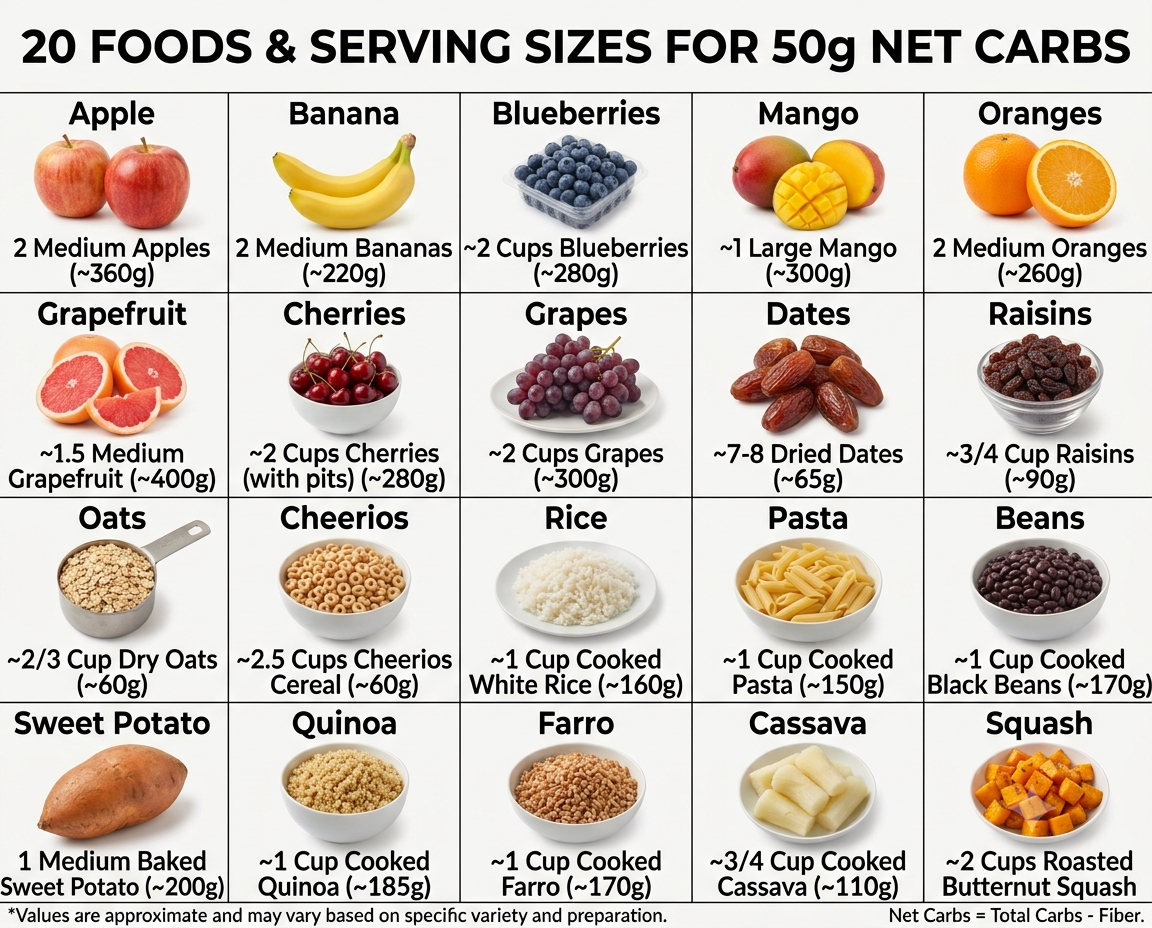
Notes- nutritional information is a bit messy which is why there is some variation. The grapes and raisin comparison might be helpful since the only real difference is the amount of water- Pet Peeve - Maltodextrin is not listed as an added sugar on food labels because regulatory definitions classify it as a complex starchy carbohydrate or polysaccharide rather than a sugar, even though it impacts blood sugar quickly---- high glycemic index (GI), typically ranging from 85 to 135, which is significantly higher than table sugar (around 65). Pure glucose is set as the baseline reference point with a maximum score of 100. Two ridiculous examples, both of which I use: e-GEL 37g of carbs, 7g of added sugar? I know it’s a sports gel but where are the other carbs if not sugar. Yes, maltodextrin. Ensure High Protein 19g of carbs, 4 g of added sugar. Worse because they market it as only 4g of sugar. Third ingredient is maltodextrin. Food literacy is another passion of mine if you can’t tell.
A few final thoughts:
Like running volume, fueling and diet can be super charged conversations. In the end, everyone has to do what works best for them. I’m in this for the long game so a healthy lifestyle is most important to me. Ninety percent of my non-running calories come from whole foods (this doesn’t count calories consumed during running). Fast absorbing, high-glycemic index sugar is super inflammatory, except during and right after exercise in the post workout window. Especially as a masters athlete, I remain interested in maximum fat oxidation and minimizing inflammation. Practicing approximately 80% of my running in zone 2, I don’t need to on board high carbs for every run. I almost never eat before running.
What are the exceptions? When the long, slow runs stretch beyond 3 hours, I am likely to eat prior. When runs stretch longer than 4 hours, I’m definitely eating prior. In all these cases, I am also fueling during the runs but typically at a rate of ~25 grams of carbs per hour. I also run fed when I am deep into big volume training blocks. In the past year, I have added more speed work (not zone 2) into my training so I fuel the 24 hours prior to these efforts specifically to assure my glycogen levels are top-off because it’s not zone 2. I have also raced a few more short distances (half marathon-ish, 3 hr efforts) this year. These require more attention to fueling before and during since they approach 3 hr tempo heart rate efforts, which is not zone 2.
For new runners: My observation is that most new runners want to run faster than zone 2. The change from fat to glycogen as the primary energy source happens quickly and steeply above zone 2 so if you’re practicing this approach and feel unusually tired, eat more carbs. A good heart monitor is a must. Also, if you haven’t practice much long, slow duration running, it also takes time to build the cellular machinery, so you might want eat some carbs.
Training and race day are two entirely different things- I’ll talk about race day nutrition soon. @middleagefast I’ll share additional examples of how I practice this on any given day. Follow and comment there.
References:
Hargreaves M. The metabolic systems: carbohydrate metabolism. In: Farrell P, ed. ACSM's Advanced Exercise Physiology. 2nd ed.Philadelphia: Lippincott Williams & Wilkins; 2012:379–391.
Murray B, Rosenbloom C. Fundamentals of glycogen metabolism for coaches and athletes. Nutr Rev. 2018 76(4):243-259.
Jensen J, Rustad PI, Kolnes AJ and Lai Y-C. The Role of Skeletal Muscle Glycogen Breakdown for Regulation of Insulin Sensitivity by Exercise. Front. Physio. 2011 2:112.
Yeo WK, Paton CD, Garnham AP, Burke LM, Carey AL, Hawley JA. Skeletal muscle adaptation and performance responses to once a day versus twice every second day endurance training regimens. J Appl Physiol. 2008 105(5):1462-1470.
Nielsen J, Holmberg HC, Schrøder HD, Saltin B, Ortenblad N. Human skeletal muscle glycogen utilization in exhaustive exercise: role of subcellular localization and fibre type. J Physiol. 2011 589(Pt 11):2871-85.